As with most Artists, it is very difficult to talk about my work. Art is a language in and of itself and any translation falls pitifully short of actually viewing the work. Interpretation of an artpiece can not ignore what the viewer brings to the image. So I choose to merely guide you through my thought processes.
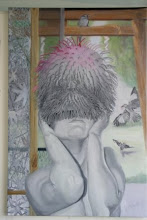
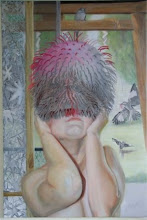
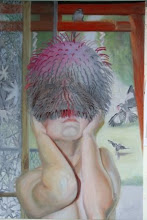
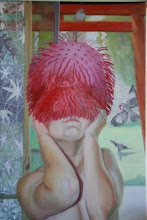
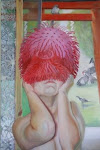
The first of my personal works here is called "Food for Thought" (Although its first title was "Round Peg Square Hole"). Medium: Oil on canvas, size: 24" X 36".
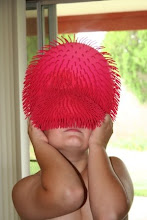
The painting began with taking a photo of my son Jack exploring his world with a fuzzy plastic ball. I was fascinated with how uninhibited he was while playing with the ball. He very quickly found new ways to experience the tactile nature of the ball and was very proud of his clever new use for it.
As I studied the photograph, I wondered why this image struck me as being so fascinating. Which led me to think about how we as humans, especially in modern times, struggle with living in our mind vs. living in the sensual, physical world. How are we evolving psychologically as human beings? How do we connect our natural (primitive) self with the technological, or conceptual, self we are creating in modern times.
And so this is how an idea begins. And as the weeks go on, you will find that I struggle to distill the subject and my composition to its purest and most unified form.
Thursday, January 8, 2009
Subscribe to:
Posts (Atom)
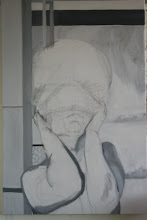
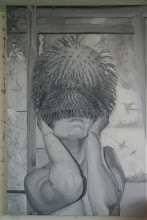
Food for thought 1, oil on canvas, 24" X 36"
I began this painting with basic decisions about composition. Very purposefully flattening out the interior of the house using it as a metaphor for the conceptual mind. Choosing The concept of line as a major element. For me this is very reminiscent of the Artist Piet Mondrian (1920s) and of Japanese Kabuki paintings (mid to late 1800s).
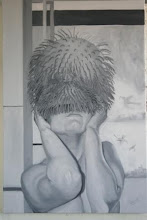
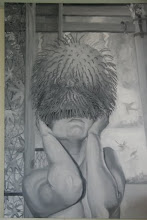
Food for Thought 3
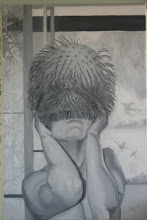
Food for Thought 4
Food for Thought 5
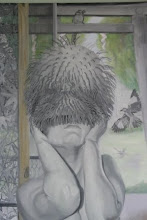
The Japanese lace paper that is beginning to emerge is a by-product of how we think of trees and leaves. So in the case of this painting I have used it as a screen or a filter by which we see nature. I keep the basic beginning divisions of that area of the canvas. but I abandon the flat "Mondrian" abstraction of the house's interior. I also am drawn to the textures and patterns I see coming out of China's Art community and the lace paper is an excuse to pay tribute to that genre (even though the paper is Japanese in origin). It is an image that I have used over many years and have made part of own personal symbolism.
Food for Thought 7
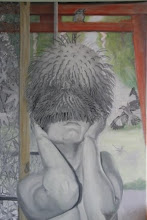
I added the element of a Shinto gate to further my message of our connection with nature. In one of the origin myths of Shintoism the goddess of the sun became annoyed with her trickster brother and hid in a cave, rolling a big rock in front of the cave and leaving the world dark. Fearful that the world would stay dark the people built a huge bird perch (the Torri) to attract many birds. When the goddess peeked out to hear the birds sing a sumo wrestler pushed the boulder from the cave and the goddess came out and the world was bright again. In the Shinto myth the gate as a bird perch fits in with the mocking birds in my painting, both with the physical connection and the metaphoric. On a personal level, it also reminds me of my grandfather who was an accomplished amateur gardener and bee-keeper.
Food for Thought 8
Food for Thought 9
Food for Thought 11
Food for thought 14
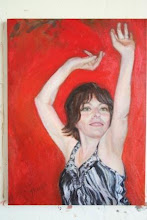
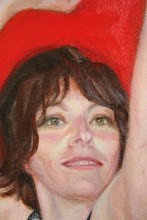
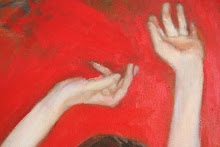
Lana detail 2 hands
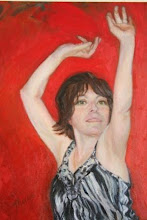
Lana day 10
Lana Day 2
Day 2 blocking in light and dark areas. getting a general likeness.
Lana
Family Fun
Dona
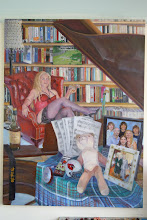
Pam in red chair
Self Portrait in progress
Charcoal on paper,18" X 24" I use alot of personal symbolism in this drawing. The rose and the rosary refer to my name. The mirror image is the artists eye. The tatoos are symbols for my children. the halo of blue tooth sticks is my need to communicate with my art. The back ground and the mocking bird are my inner eye and the vehicle by which I transport the things I think about to the phyical world.